Education as we knew it has begun to be redefined. Under pressure from both technological progress and students’ changing needs, modern teaching practices are now turning to approaches that spark interest and strengthen active participation. One of the most interesting and widely discussed approaches of recent years is gamification: bringing the logic of games into learning.
Gamification is not the game itself. It does not mean a classroom turns into an amusement park or that the seriousness of knowledge gives way to entertainment. Instead, it is the targeted integration of game elements, such as challenge, progress, rewards, recognition and competition, into the teaching process. It is an effort to give the learning experience the kind of framework that keeps students motivated, focused and willing to take part.
The power of gamification rests on people’s innate need for progress, for trying things out, for understanding and, ultimately, for success. Students who enter a learning rhythm based on game elements do not necessarily learn more easily, but they certainly learn with greater consistency and staying power. This happens because knowledge is not imposed on them, but revealed through successive successes and small wins, with the students themselves at the wheel.

A question often asked is whether this approach suits every age. The answer is yes, as long as it is done with care and adaptation. For young children, play is a natural way of learning. For teenagers, the idea of challenge and competition can give meaning and interest even to demanding subjects. In adult education, where time and concentration are limited, gamification works as a way of boosting participation and motivation, and as a tool for tracking one’s own progress.
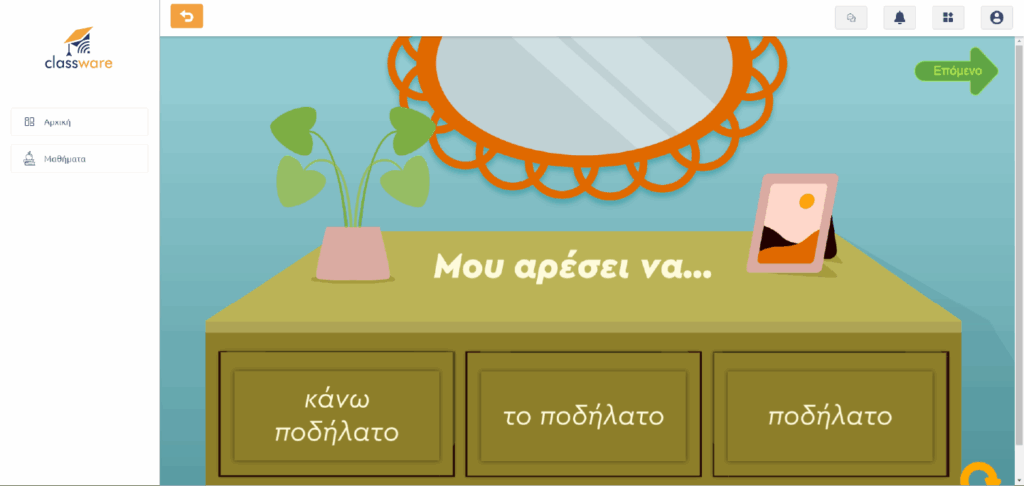
Technology now provides the framework for gamification to be applied in a meaningful and practical way. Platforms such as Classware let teachers include timed quizzes, collect students’ answers and follow their progress through organised courses and activities. The interactive whiteboard allows real-time collaboration and encourages students’ active participation through creative interaction. Even more importantly, Classware supports adding educational games through SCORM technology, making it possible to bring in interactive content designed specifically for the needs of a course.
Such games can be created with the help of the Classware team, which makes things easier for teachers who are not technically confident but have a clear educational goal. In this way, gamification does not require complex tools or special skills, only creative intent and the right guidance.
The central message is not that everything should become a game. It is that learning can become more meaningful when it comes with interest, participation, goals and recognition. Applied with moderation and purpose, gamification is much more than a “trick” to grab students’ attention. It is a strategy that strengthens the student’s cognitive and emotional connection with what they are learning.
In a world where attention is the new precious currency, teachers are called on to find ways to inspire, not just to transmit. Gamification is one of them. And perhaps, at the end of the day, it is not so far from the very nature of learning: a continuous process of discovery, effort and growth, just like a good game.