
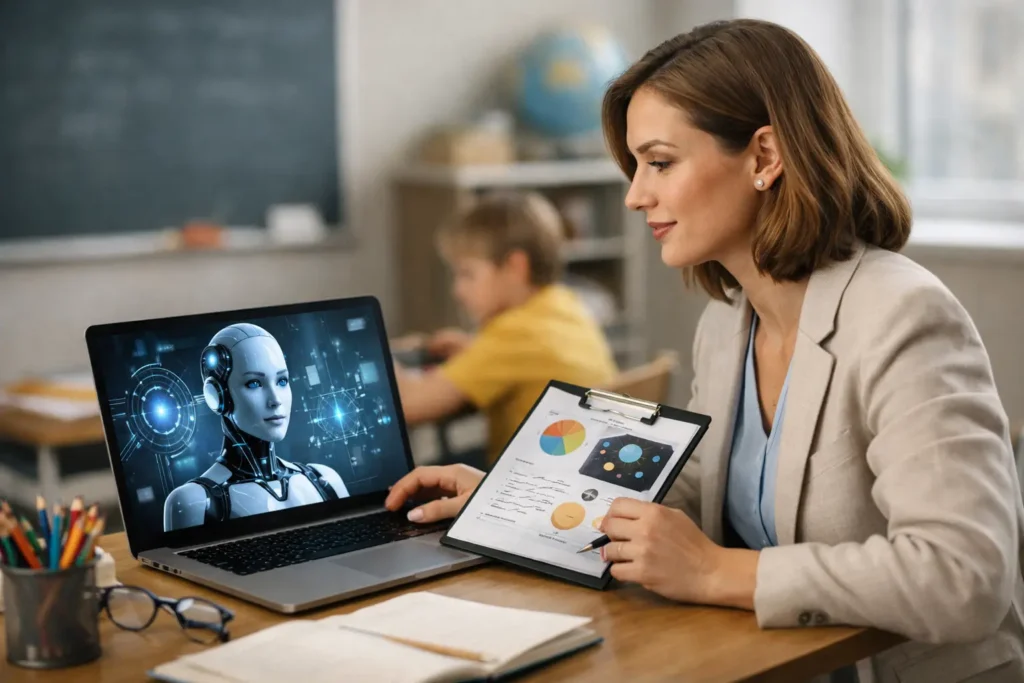
A teacher does not lose time only in the classroom. They lose it before the lesson, preparing material; after the lesson, answering questions; and in between, trying to keep track of who is participating, who is falling behind and who needs extra support. That is exactly where an AI assistant for teachers gains real value: not as an impressive tool, but as a practical way of supporting everyday teaching.
The conversation about artificial intelligence in education is often abstract. In practice, though, teachers do not need another platform that adds steps. They need an environment that reduces fragmentation, organises their workflow and lets them teach with more continuity. AI’s role is not to replace the teacher. It is to give back time, visibility and control.
What an AI assistant for teachers means in practice
The term sounds broad, but its usefulness is judged in very specific places. An AI assistant for teachers can support creating activities, suggest assessment questions, help word announcements, organise learning material and make it easier to respond quickly to students’ needs. Its value increases when all of this happens within the same digital ecosystem where the lesson, communication and progress tracking take place.
This matters because fragmentation is one of the biggest problems in modern teaching operations. When one tool is used for live lessons, another for exercises, another for messages and another for files, teachers spend energy on administration rather than teaching. An AI assistant delivers most when it works as part of a single platform rather than as an isolated add-on.
Where teachers save time
The first and most immediate benefit is time saved on preparation. Creating quizzes, drafting lesson plans or adapting instructions for students at different levels are tasks that pile up. Teachers remain responsible for educational quality, but they do not start from scratch every time.
The second benefit concerns communication. In organised education settings, teachers are often asked repeated questions about deadlines, material, instructions or access to activities. A well-integrated assistant can support this flow, reducing the operational load without losing the teacher’s personal presence.
The third concerns tracking the learning journey. When teachers have a quick picture of participation, delays, performance and points of difficulty, they can step in earlier. This is especially critical in schools, tutoring centres, university departments and blended learning settings, where students’ ongoing engagement cannot be taken for granted.
An AI assistant for teachers is not the same for everyone
There is a key trap in these discussions: assuming every teacher needs the same thing. That is not true. In primary education, the emphasis may be more on simple communication with parents and students and on quickly adapting activities. In secondary education, organising material, assessments and participation tracking often come first. In higher education, scaling, supporting large groups and managing mixed forms of teaching play an important role.
Likewise, the needs of an individual teacher differ from those of an organisation that wants a unified experience for departments, management, students and parents. That is why the discussion should not start from what AI “does”, but from how it fits into the flow of teaching and administration.
What a school or teacher should watch out for
Effectiveness does not depend only on the tool’s capabilities, but on the context in which it is used. An AI assistant that generates text or questions can be useful, but if it is not connected to classes, courses, assignments, statistics and communication, its practical value is limited. The same applies when using it requires constant switching between apps.
Attention to educational consistency is also needed. Automation can speed up content creation, but it does not guarantee quality, clarity or suitability for every age group. Teachers must always have final control over language, difficulty level and the learning objective. AI is an accelerator, not a judge of academic accuracy.
Another point is accessibility. In a modern learning environment, support must follow the user, whether they work from a computer or a mobile device. When teachers and students can continue the learning process without technical obstacles, technology stops being an extra burden and becomes part of daily life.
From producing material to continuous learning support
The most interesting point is not that an AI assistant writes text quickly or builds a quiz. Those are useful functions, but not the most important level of value. The biggest change comes when the assistant supports a continuous learning experience: before the lesson with preparation, during it with immediate support for participation, and after it with feedback, reminders and progress tracking.
This is critical for institutions and organised education providers that want a consistent learning experience. When the course, assignments, announcements, live sessions and support sit in a shared environment, teachers do not just manage their time better. They create the conditions for continuity for students.
This is where the single-platform logic has a clear advantage. A solution such as Classware makes sense not because it adds yet another AI feature, but because it places that support within a complete learning environment with courses, live sessions, assessments, mobile access and central communication.
The real limits of AI in education
A clear view is needed, not hype. An AI assistant cannot read the mood of a class the way an experienced teacher does. It does not always understand cultural nuances, emotional changes or the fine balance between encouragement and discipline. It does not know on its own when a student is bored, when they are too embarrassed to ask or when a group needs a change of approach.
That is why its most meaningful applications are not those that promise full automation, but those that support the teacher’s professional role. The best use is collaborative. The person sets goals, judges, corrects and steps in. The system organises, speeds things up and provides operational support.
What mature use looks like day to day
A mature approach starts with small, recurring needs. Teachers can use the assistant to draft first versions of exercises, turn notes into more structured material, adapt instructions for different classes and identify more quickly which students need intervention. Management, for its part, cares about coherence, statistics and smoother teaching operations.
Over time, the value shifts from the individual task to the overall experience. Teachers face less friction day to day. Students find more immediate support. Parents get a better picture. And the organisation runs with more continuity, without relying on scattered tools that do not communicate with each other.
So the right question is not whether artificial intelligence has a place in education. The right question is whether the way it is applied really serves teaching, organisation and learner participation. When an AI assistant for teachers is part of a connected, practical and accessible environment, it stops being a trend and becomes an everyday advantage: quiet, but substantial.