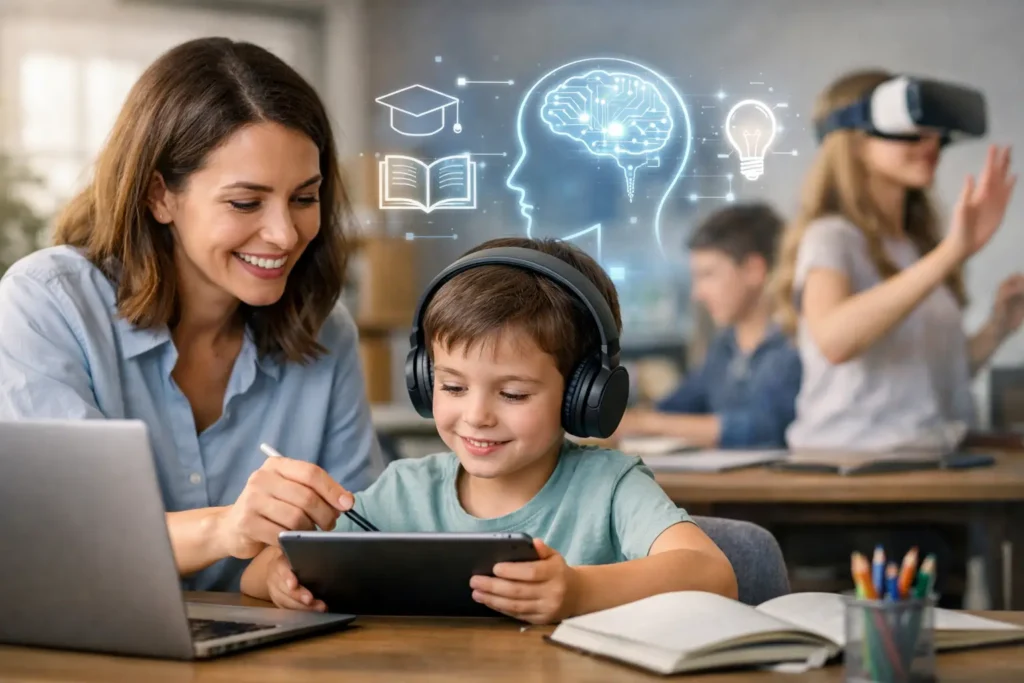
A student finishes exercises on their phone on the bus, a teacher sees in real time who is struggling before the next lesson, and a parent stays informed without waiting for the end-of-term report. This is not a distant scenario. It is the setting in which the future of personalised learning is already taking shape.
For schools, universities, tutoring centres and organised education providers, personalisation no longer simply means “different material for different students”. It means a continuous, connected learning experience that adapts to each learner’s needs, pace, gaps and goals, without burdening the teacher with more administration.
What really changes in the future of personalised learning
For years, personalised learning was presented as an educational ideal, but in practice it was hard to apply at scale. The reason was simple. Teachers had limited time, progress data was scattered and digital tools often worked in isolation.
Today this is changing because technology is no longer limited to delivering content. It can support the entire learning journey. From diagnosing needs and assigning activities to live teaching, assessment, feedback and communication with parents, everything can sit together in a single environment.
This is the turning point. The future does not belong to more standalone tools, but to platforms that connect learning at every stage. When the digital ecosystem is unified, personalisation stops being a theoretical promise and becomes a working reality.
From the same lesson for everyone to dynamic adaptation
The traditional logic of teaching is based on a shared flow: the same lesson, the same time and the same assessment for everyone. This remains useful in many settings, especially when a common academic foundation or coordinated class progress is needed. But it does not always respond to the real differences between students.
Modern personalisation is moving towards a more dynamic approach. A student who has mastered a concept can move on to more demanding activities. One who needs support can get revision, a different kind of explanation or extra practice. The teacher does not lose control of the class. On the contrary, they get a better picture of where intervention is needed.
The point is not to design an entirely different lesson for each person. It is to have room for adaptation within a shared educational strategy. That is what makes personalisation workable and pedagogically balanced.
The role of data, without the hype
Learning data will play a central role in the coming years, but not in the way it is often presented. Collecting statistics is not enough. They need to be turned into a useful picture for the teacher and the organisation.
When a platform shows which students are consistently not logging in, which unit shows low performance or who needs feedback before an assessment, data gains educational value. It becomes a tool for early intervention, not just reporting.
There is a limit, though. Not every element should become a measurement, nor every measurement a decision. Learning includes factors that are not easily captured in tables: confidence, fatigue, family circumstances, motivation. That is why technology is most valuable when it strengthens the teacher’s judgement, not when it tries to replace it.
AI will be an assistant, not a substitute
The debate about AI in education often swings between two extremes: over-optimism or anxiety. In practice, the most meaningful use of artificial intelligence in personalised learning is far more specific and far more useful.
AI can help create differentiated activities, suggest next steps based on progress, answer common questions outside teaching hours and support students with instant guidance. For institutions and teachers, this means less time on repetitive tasks and more time for teaching with substance.
Even so, quality depends on context. An AI answer without instructional design can be generic, wrong or unsuitable for the student’s level. That is why the future of personalised learning will not be decided by the presence of AI alone, but by how it is integrated with safety, oversight and a clear educational role.
A unified learning experience will matter more than individual features
Many institutions already have digital tools. The problem is that they are often disconnected. One system for the course, another for video conferencing, another for announcements, another for assessments. This creates friction for everyone: teachers, students, management and parents.
The next phase of personalisation requires continuity. If students attend a live lesson, take a quiz, receive feedback, return to asynchronous material and communicate within the same environment, the experience becomes clearer and more effective. Progress is visible, data stays in one place and intervention happens faster.
This is also why organisations are turning to platforms that combine an LMS, a virtual classroom, mobile access and AI support in a single structure. For example, an environment such as Classware does not treat personalisation as a separate add-on, but as the result of connecting all the key learning functions.
Mobile learning is not just convenience
Mobile access is often treated as a secondary feature. In reality, it is a key driver of participation. When students can view material, receive notifications, submit an assignment or join an activity from wherever they are, learning becomes more continuous.
This matters especially in busy schedules, for university students who commute, for learners who need flexible access and for families who want better visibility into progress. Personalisation is not only about content. It is also about how learners get access.
Personalisation will extend to communication
An often overlooked point is that learning does not happen only inside the lesson. It also happens through reminders, interventions, messages of encouragement and timely updates to parents or management where needed.
In the future, the education systems that stand out will be those that personalise not only content but communication too. A student who is consistently late may need a different kind of notification from a student who participates but performs poorly. A parent may need a concise view of progress, while an academic adviser needs more detailed data.
Targeted communication improves consistency and reduces missed interventions. But balance is needed here too. Too many notifications are tiring and eventually lose their value. Good personalisation is precise, not noisy.
What education institutions should watch out for
Technology on its own is not enough. An institution can invest in advanced tools and still fail to achieve meaningful personalisation if educational strategy, training and proper implementation are missing.
First, the goal needs a clear definition. A school that wants better support for students learning at different paces needs something different from a university that wants early detection of dropout risk. Personalisation is not the same for everyone.
Next, the platform must make everyday use easy. If the system is complicated, teachers will use it piecemeal and the experience will fragment. Usability is not a secondary issue. It is a precondition for success.
Finally, attention is needed to privacy, transparency and reliability. The more data and AI are used, the more important it becomes to have clear rules on what data is collected, how it is used and who has access.
The future of personalised learning will be more human than we think
There is an impression that the more digital education becomes, the more impersonal it will end up. In practice, the opposite often happens. When repetitive processes are automated and information is brought together, teachers have more room for what matters most: observing, guiding, encouraging and stepping in at the right moment.
The real aim is not to build a system that mechanically adapts to every click. It is to build a learning environment that recognises each learner progresses differently, while remaining part of a cohesive learning community.
That is where the next decade of digital education will be decided. Not by how many tools we have, but by whether they can truly support an education that is more flexible, more accessible and closer to the real needs of the people who live it every day.